

Pinguicula zecheri can make a dramatic flowering plant, but flower size alone does not settle its identity. Its history combines a recognised botanical name, a later nomenclatural correction and continuing discussion about its relationship with P. moranensis.
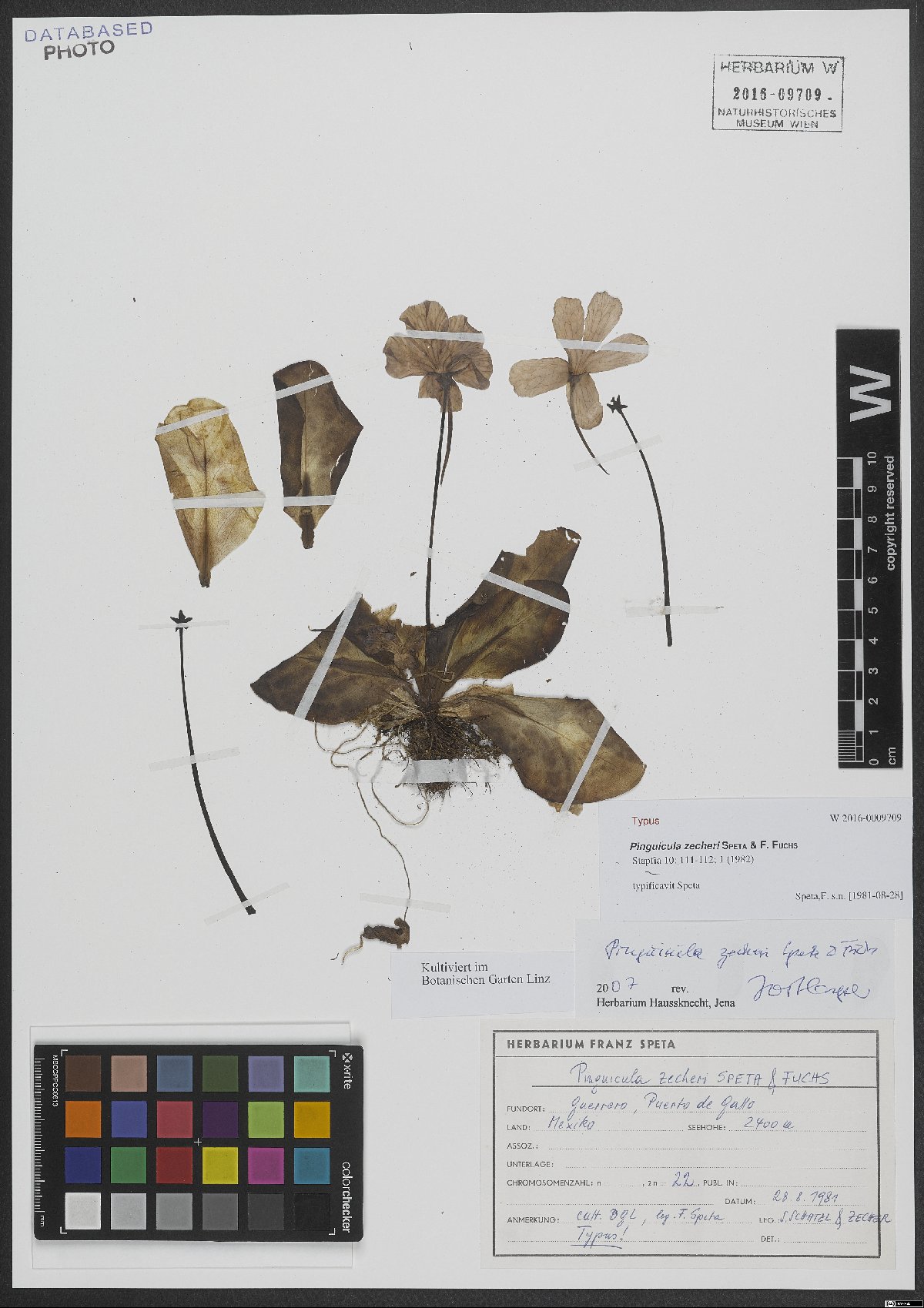
Name and taxonomic status
Kew currently accepts the species and gives its range as Guerrero and Michoacán, Mexico. Older references cite Speta and Fuchs’s 1982 description. IPNI explains that the original name was invalidly published because the holotype was not clearly indicated; validation followed in 2016. These dates describe different steps, rather than competing discovery dates. Kew species record; IPNI validation record.
Appearance and mountain habitat
Zamudio’s 2001 treatment describes a broad summer rosette 12–22 cm across, contrasting with a small resting rosette of numerous fleshy leaves. The purple flowers have a darker centre, an elongated white throat marking and a long spur. Summer-leaf margins roll inward. The account places plants on humid, steep banks, rock faces and sometimes tree trunks with mosses, in cloud forest or moist pine–oak forest at 1,900–2,600 m. Flowering was observed while summer rosettes remained present; leaves progressively shortened during the transition to rest. Zamudio, 2001, species treatment.
The same treatment distinguishes its humid upland setting from the lower-elevation gypsum habitat of P. colimensis, while acknowledging greater difficulty separating some specimens from P. moranensis. This is why a photograph of one unusually large bloom is insufficient for a confident determination. Taxonomic comparison.
What growers and field observers report
Fernando Rivadavia questioned species rank after observing variable flowers around Puerto del Gallo, favouring a broad moranensis interpretation. This is an explicitly attributed opinion; it does not replace Kew’s accepted treatment used for this encyclopedia. Keep accession names and supporting observations together so that future taxonomic changes do not erase provenance. Rivadavia’s observations.
The French cultivation account on the same specialist page uses a mineral medium, moving air and slight drying between active-growth waterings. Its dry-medium resting period was accompanied by high atmospheric humidity. That combination should not be translated into exposing a resting plant to dry indoor air for months. The grower recommends following the change in leaf type rather than the listed Northern Hemisphere calendar. Cultivation account.
Propagation and useful records
The grower reports success with resting leaves removed with their bases intact, but had not yet flowered the accession when writing the propagation notes. The page therefore does not demonstrate seed production or germination. Propagation notes.
For a collection record, photograph both seasonal rosettes, leaf margins and the flower from front and side. Keep any cultivar name separate from the species description: this profile does not authenticate a named clone. Numerical temperature limits, multiplication rates and a Nano Nursery seed protocol remain unverified. The practical priority is an identified accession with an observed seasonal cycle, rather than a universal schedule inferred from its impressive flowers.


