

A tray of small Mexican butterworts can contain several species, hybrids and named clones that look remarkably similar. A pink rosette is attractive, but colour alone cannot tell you whether it is Pinguicula esseriana, P. ehlersiae, P. jaumavensis or something else. Reliable identification begins with a record of the whole plant over time.
What this guide can establish
This is an observation guide for growers, not a botanical key. It explains what evidence to collect before comparing a plant with an original description or asking a specialist to examine it. “Small Mexican rosettes” is an editorial grouping used here for convenience, not a taxonomic section or a claim that every small plant shares the same care needs.
Why the names can be difficult
In his 2004 field account, Fernando Rivadavia recorded substantial variation in flower colour, lobe shape and throat markings among populations he compared with P. esseriana, P. ehlersiae and P. jaumavensis. His uncertainty is useful evidence of a difficult identification problem; it is not, by itself, a formal decision to merge those species. See A Trip to Northeast Mexico.
Botanical treatments can also differ. Zamudio’s thesis discusses P. ehlersiae at varietal rank under P. esseriana. Our series retains the separate entries in its dated Kew baseline while recording alternative treatments alongside them. A disagreement between references should remain visible rather than be “resolved” by changing a plant’s label without evidence. See Zamudio’s taxonomic treatment.
Colour and diameter are supporting observations
Measure the diameter, but also record whether the plant is mature, newly propagated or changing seasonal leaf form. Photograph colour under neutral lighting and keep unedited originals. Avoid comparing a strongly tinted promotional image with a plant under a different lamp and treating the difference as botanical evidence.
For each photograph, include the date, the exact label and a scale placed beside the plant. Keep camera position reasonably consistent. This approach does not remove biological variation, but it removes some avoidable uncertainty from your records.
Look at the architecture of a leaf
Record the outline, the widest point, the tip and the way the margin is held. Photograph a leaf in place rather than flattening it for a neater image. Note whether the rosette is composed of broad overlapping leaves, narrower leaves or a mixture of older and newer forms. Write observations in ordinary language first; unfamiliar botanical terms are less useful than an accurate photograph.
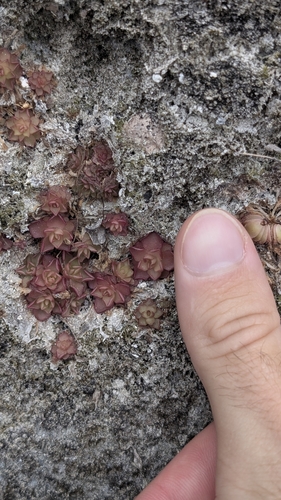
Season must be recorded with morphology. The original P. jaumavensis diagnosis, for example, describes different dry- and wet-season foliage. Comparing its resting leaves with the active leaves of another plant would obscure that distinction. See Debbert’s diagnosis as reproduced by A World of Pinguicula.
Photograph flowers from more than one angle
A front view records lobe shape and throat markings. A side view shows the tube, spur and the angle between the flower parts. A close view of the throat can reveal hairs that disappear in a distant photograph. Repeat the record for more than one flower when possible, especially if the first is damaged or has not fully opened.
As an example of why the side view matters, the reproduced P. jaumavensis description gives a spur of 4–6 mm, whereas the P. esseriana diagnosis describes a substantially longer spur. Those original descriptions offer characters to investigate; they do not make a single spur measurement a universal identification test. P. jaumavensis diagnosis; P. esseriana diagnosis.
Flower characters are valuable, but flower resemblance alone does not establish evolutionary relationship. Fleischmann’s review explains why classifications based heavily on floral appearance can disagree with molecular evidence. See On the infrageneric classification of Pinguicula.
Keep provenance attached to the observations
Save the original supplier wording, acquisition date and any accession or locality information. Keep a photograph of the label. If you later add an identification note, retain the earlier wording and the reason for the change. A locality name copied from an online photograph is not provenance for your plant.
Likewise, separate a documented cross from a suggested resemblance. “Looks like P. esseriana” and “raised from a recorded cross involving P. esseriana” are different statements. Neither should be shortened to a confirmed species label without further support.
A useful identification packet
- The exact original label and source, including any uncertainty.
- One whole-plant photograph with a scale.
- A close view of leaf shape and margins.
- Flower photographs from the front and side, with a throat detail if possible.
- The date and observed growth phase.
- Photographs of the other seasonal form, if you have them.
- The reference or description you are comparing against, with the characters that appear to agree or disagree.
Send the evidence as a set. A specialist can do more with a modest, well-documented packet than with many nearly identical overhead photographs. If a determination remains uncertain, retain that uncertainty explicitly.
Identification and care are related decisions
Do not force an unconfirmed plant into a strict dry-rest programme solely because its rosette resembles a photograph. Preserve the successful care history supplied with that plant, observe its actual seasonal change, and seek species-level evidence before making a major adjustment. A reliable record helps with both tasks: it supports future identification and shows how the individual plant responded in your conditions.
Part of the Nano Nursery Pinguicula Encyclopedia. Sources checked September 2026. The photographic checklist is an editorial recommendation; it is not a substitute for a formal taxonomic determination.


