

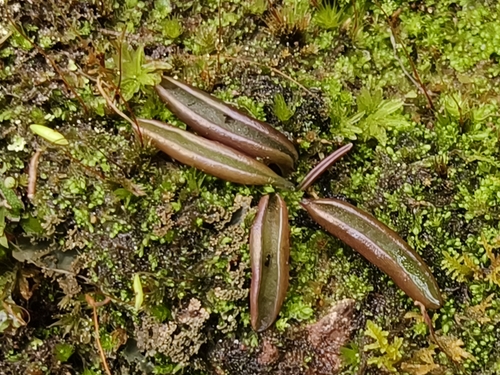
Pinguicula parvifolia rewards close inspection. Its small leaf blades and slender stalk-like bases give the growing rosette a different character from the broad, overlapping leaves familiar in many Mexican butterworts. Understanding its seasonal change is more useful than judging its health by rosette diameter alone.
Name and identity
Kew accepts Pinguicula parvifolia B.L.Rob., first published in 1894, as a perennial native to Mexico. That is the species concept used in this encyclopedia; a nursery locality label should be retained separately from the botanical name. Kew species record.
Leaves, flowers and habitat
Casper’s description, reproduced by A World of Pinguicula, distinguishes numerous narrow resting leaves from relatively few summer leaves. The latter have blades about 5–9 mm long on bases about 8–14 mm long. Resting leaves can have conspicuously hairy margins. Flowers are whitish to purple-blue, with a yellowish throat. The type locality is in the Sierra de San Esteban near Guadalajara, Jalisco. Species account and reproduced description.
In their 2006 field account, Noah Elhardt and Forbes Conrad found plants scattered across an oak-covered forest floor, particularly on small rises and banks. They recorded clay and mossy rock surfaces, while expressing uncertainty about the rock’s identification as granite. Rosettes varied from dark green to maroon. Most mature plants already carried developing seed capsules, although some flowers remained. Elhardt and Conrad’s field report.
Those observations matter because a tiny plant can occupy several neighbouring surfaces within one habitat. Copying the appearance of one rock in a photograph does not recreate the moisture and shade around its roots.
Seasonal care
The published cultivation account records carnivorous leaves during active growth and a compact, non-carnivorous resting rosette. Its author uses a mineral medium, waters during growth and allows a dry rest in a humid greenhouse. This is a documented growing method, not a requirement to leave every indoor plant unwatered for the same number of months. Cultivation observations.
For an Australian collection, record the transition your own plant makes rather than copying a northern-hemisphere calendar. The ICPS emphasises matching a Mexican butterwort’s medium to humidity and watering practice, with seasonal lighting cues for species that change leaf form. ICPS growing guide.
Propagation and useful records
The species account recommends intact resting leaves, including their pale bases, for leaf propagation; summer leaves are reported to be harder. Keep each propagated batch linked to its parent label. Propagation observations.
The 2006 observers also saw small beetles visiting flowers and interpreted them as pollinators. Their account is a useful lead, but does not establish the species’ complete pollination biology. Field observations. In cultivation, distinguish a flower opening from a capsule actually producing seed. Photographs of both rosette phases, flowers and the original label provide a much stronger record than a single overhead image.


