

Pinguicula medusina changes dramatically through its annual cycle. During active growth, slender leaves spread away from the centre and may carry tiny daughter plants at their tips. During rest, the visible plant can retreat beneath the surface. Learning to recognise both stages makes this species much easier to interpret.
At a glance
- Accepted name: Pinguicula medusina Zamudio & Studnicka.
- Family: Lentibulariaceae.
- Native range: Guerrero and Oaxaca, Mexico, in Kew’s current treatment.
- Distinctive features: long active leaves, leaf-tip vegetative buds and a buried resting rosette.
- Main care distinction: a pronounced dry resting phase.
Kew accepts the species, first published in Acta Botanica Mexicana 53:68 in 2000. Its range is broader than the single Oaxaca locality described in some older horticultural accounts. Plants of the World Online.
How the species was distinguished
Zamudio and Studnička described P. medusina from gypsum hills near Santiago Juxtlahuaca, Oaxaca. Their paper compares it with P. heterophylla, emphasising flower-lobe form and position, vegetative buds at active-leaf tips and the gypsum habitat. The two species share long, narrow leaves, making those additional characters important. Original species publication, 2000.
Older cultivated material circulated under names including “alfredae”. The historical account links those labels to plants introduced by Alfred Lau before the formal description. Retain an old label in an accession’s history, but do not silently convert every plant bearing it without checking the evidence. A horticultural name and a verified botanical synonym are different kinds of record. Horticultural history.
Life on gypsum hills
In 2009, Oliver Gluch observed abundant plants on a gypsum hillside near Laguna Encantada after rain. He recorded both reddish and greener plants, and noted that fewer than half were visibly producing leaf-tip plantlets during that visit. This matters for identification: the absence of plantlets in one photograph does not rule out P. medusina. Field observations.
The report is an account of one place and time, not a complete survey of the range now listed by Kew. Keep habitat observations and distribution statements separate when researching the plant. An old sentence saying that only one population was known should not be repeated as a present-day conclusion.
Three visible stages
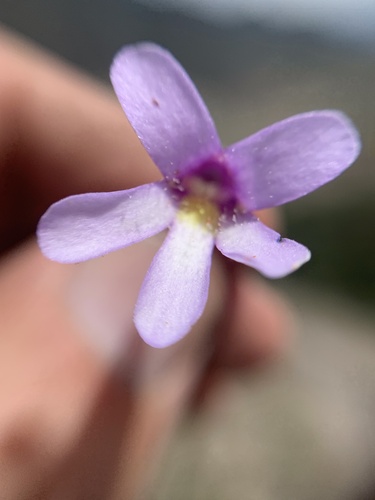
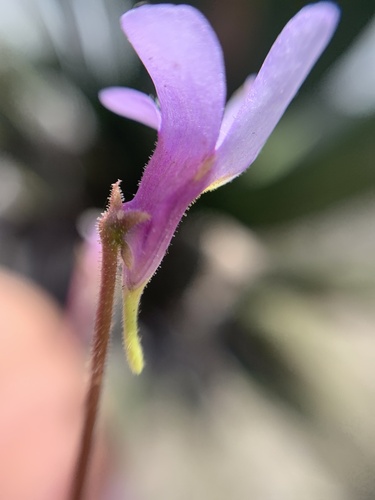
The reproduced description records long active leaves reaching 70–190 mm and shorter transitional leaves. Flowers are white or white with violet edging, with a short spur described as 3–5 mm. The resting structure is a compact, bulb-like rosette rather than an ordinary exposed summer crown. These features should be assessed together. Morphological description.
- Rest: a small, inconspicuous structure may be concealed by the medium and old foliage.
- Transition: shorter leaves appear before the characteristic long foliage becomes obvious.
- Active growth: the mature leaves provide the best opportunity to record their shape and any developing plantlets.
Photograph the sequence without repeatedly excavating the plant. Place a marker beside its position before it becomes difficult to see. This simple step keeps an occupied pot from being mistaken for an empty one.
Watering follows the plant’s phase
Eric Partrat’s account describes a buried resting rosette protected by dried leaves. In his humid, ventilated French greenhouse, active plants receive rainwater with some drying between waterings; the pot is allowed to become dry as rest develops. Water is reintroduced progressively when active growth returns. His months describe his greenhouse season and should not be copied directly into an Australian calendar. Cultivation observations.
For an established plant, keep the pot where moisture can be checked without digging into the centre. If plants with different resting requirements share a tray, separate the watering arrangements before the seasonal change makes that awkward. Do not try to force a resting plant into activity merely because its neighbours remain leafy.
The ICPS explains that Mexican butterwort media must be matched to watering, humidity and temperature. A mineral ingredient list alone cannot tell you how long your pot will stay wet. Use a documented approach for the species and record any adjustments, especially after moving between a greenhouse and an indoor shelf. Growing-medium context.
Leaf-tip plantlets and propagation
Vegetative buds on the active-leaf apex are one of the characters highlighted in the original description. They provide a propagation route and a useful feature to photograph, but their absence must be considered alongside the field observation above. Original description.
Record the daughter plant under its parent’s accession before separation. Avoid treating every swelling as an independent established plant; look for clear development and roots. If attempting leaf propagation, the general ICPS guidance supports gentle handling and avoiding a container that is either persistently wet or so dry that the material shrivels. These are general principles rather than a promised production rate for this species. ICPS propagation guidance.
Keeping a useful species record
Keep the original supplier label, a flower photograph, the seasonal sequence and propagation history together. Note whether “alfredae” appeared in the original documentation rather than adding it because a plant resembles an online image. A profile can explain the species; it cannot authenticate an individual clone or its locality.
The most informative view of P. medusina is a full year of growth. The long leaves, emerging plantlets and quiet resting stage become parts of the same plant, rather than three unrelated appearances requiring three different guesses.
Part of the Nano Nursery Pinguicula Encyclopedia. Sources checked September 2026. Cultivation guidance concerns established plants; tissue-culture material needs a separate acclimatisation process.


