

Pinguicula gracilis is a small butterwort with a disproportionately expressive flower: the middle lobe of its lower lip extends beyond its neighbours. Its seasonal rosettes and sheltered rock habitat distinguish it from an interchangeable “miniature ping”.
Identity and range
Kew accepts Pinguicula gracilis Zamudio, described in 1988, as a perennial native to Coahuila and Nuevo León, Mexico. Older horticultural accounts focus on Cerro de las Mitras near Monterrey; that locality should not be mistaken for the whole distribution accepted today. Kew species record.
Recognising the flowers and leaves
The botanical description reproduced by A World of Pinguicula gives spoon-shaped summer leaves about 8–16 mm long and smaller winter leaves about 3–12 mm. Flowers are white with purple throat markings and a yellow-green patch on the lower lip. The notably elongated middle lower lobe and short spur are useful features to photograph. Description and species history.
That account explains a historical confusion with P. pumila. A small rosette and a pale flower are therefore insufficient identification on their own. Preserve a side view of the spur, a face view of the flower, leaf measurements and provenance together. Historical identification context.
Habitat and seasonal observations
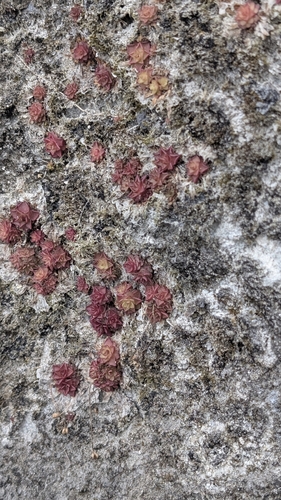
In December 2008, Fernando Rivadavia found compact winter rosettes in dry mosses on a shaded rock wall in the Chipinque area. Young flower stalks were emerging, but flowers had not yet opened. The report, published in 2010, documents a particular stage of a wild population rather than a fixed flowering month for every cultivated plant. Primary field report.
The specialist species account records limestone cliffs and wooded settings. Taken together, these observations support attention to shelter and seasonal moisture rather than assuming that every Mexican butterwort naturally grows in hot, exposed ground. Habitat account.
What recent population research adds
A July 2026 study examined populations at Mitras Mountain, Chipinque Ecological Park and San Lorenzo Canyon. Smaller or more isolated patches showed poorer reproductive performance, particularly in fruit and seed measures. Its population estimates used photographs, area estimates and extrapolation; they are research estimates, not an exact census of every plant in the species. Gallardo-Sánchez and colleagues: population and patch size.
The study gives a practical reason to value locality records and genetic diversity. Many pots propagated from one plant remain one clone; they do not represent the full diversity of a wild population. This distinction matters when describing the conservation value of a collection.
Growing and propagation
Eric Partrat reports a seasonal succulent rosette, flowering from that phase, cultivation in a mineral medium and successful propagation with leaf pullings. His dry-rest method operates in humid greenhouse air. The account should be read as one grower's method, with humidity and growth stage retained as part of its context. Cultivation observations.
For an Australian accession, follow emerging leaf form rather than copying Northern Hemisphere months. Keep the parent plant labelled while establishing propagules, and record which seasonal leaves were used. Do not treat a flower stalk as proof that the plant has resumed its larger carnivorous rosette.
The sources reviewed here support the species identity, seasonal cycle and several propagation observations. They do not establish a universal optimum temperature or a guaranteed seed-germination rate. Authenticated images and an accession-specific growing record remain outstanding before publication.


