

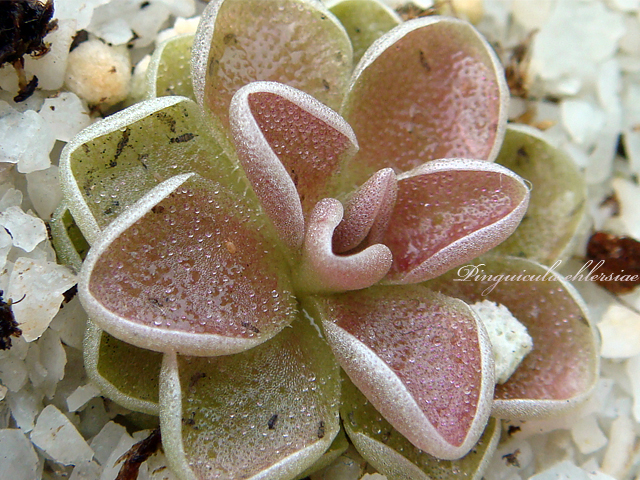
Pinguicula ehlersiae is a compact Mexican butterwort whose small rosette can hold surprisingly large flowers. Its appeal is in the detail: overlapping leaves, shifting seasonal proportions and a long floral spur. Understanding those details also helps separate a useful identification from a guess based on pink foliage.
At a glance
- Accepted name: Pinguicula ehlersiae Speta & F.Fuchs.
- Family: Lentibulariaceae.
- Native region: northeastern Mexico in Kew’s treatment.
- Growth pattern: different carnivorous and succulent seasonal rosettes.
- Main care distinction: adapt moisture to the leaf phase; a small resting rosette does not need the same routine as active foliage.
Botanical status follows Plants of the World Online; seasonal morphology is described in Oliver Gluch’s species account.
History of the name
Speta and Fuchs published the species in Stapfia 10 in 1982. IPNI records that the name appeared as “ehlersae” in the original publication; the accepted spelling used here is ehlersiae. That older spelling can therefore appear in bibliographies without representing a different plant. IPNI nomenclatural record.
The specialist account connects the name with Renate Ehlers, who collected the source material near Guadalcázar in San Luis Potosí in 1979. Plants were subsequently grown at the botanical garden in Linz. Origin and horticultural history.
Kew lists P. hintoniorum B.L.Turner as a synonym. Other treatments have drawn the boundary differently: Zamudio’s thesis places ehlersiae at varietal rank under P. esseriana. The encyclopedia uses Kew’s separate species entry while recording that alternative concept. Kew synonymy; Zamudio’s treatment.
Habitat: a small plant in a varied landscape
Gluch describes plants on limestone or gypsum, often on shaded slopes or vertical surfaces. His account also notes difficulty drawing an exact range because separation from P. esseriana is not always straightforward. The substrate and exposure observations are useful; an apparently precise range should still be read alongside that taxonomic qualification. Habitat account.
Fernando Rivadavia’s northeastern Mexico field report documents wide variation among populations compared with these small-rosette species. That is a reason to preserve locality information when it is genuinely documented. It is not a reason to assign a locality to an unlabelled plant because its flowers look similar. Field observations.
Leaves and flowers
Gluch describes the active rosette as having roughly 20–30 wedge-shaped leaves and the resting rosette as having about 40–60 smaller leaves. He records violet to pink flowers, sometimes white, and a spur reaching about 22 mm. These measurements describe the material in that account; they are not a pass-or-fail test for every cultivated specimen. Morphological description.
To compare a plant properly, photograph its flower face, side profile and throat. Include the spur in full and place a scale beside the plant. Record the leaf phase at flowering. The outline of the rosette and the colour of its leaves can help describe it, but neither is sufficient to settle its identity.
Take particular care with the old name P. cyclosecta in horticultural records. The specialist ehlersiae page records a misapplication of that name in cultivation. A misapplied name is different from a botanical synonym: it does not mean that the correctly identified species P. cyclosecta is the same plant. Historical naming notes.
Growing through the seasonal cycle
Use the plant’s emerging foliage to recognise the transition. As several successive leaves become smaller and more crowded, reassess watering instead of waiting for every older leaf to disappear. The species account describes a markedly drier resting phase and a gradual return to watering as carnivorous leaves emerge. Its months refer to a Northern Hemisphere greenhouse. Cultivation observations.
For Australian conditions, retain the sequence of events and discard the assumption that the same month must produce the same plant response. A pot under artificial light may also follow a different timetable from one exposed to seasonal daylight. Keep a dated photograph when the change starts; it gives you a reference for the following year.
A practical setup
Provide a bright position and a draining pot with an open medium. Gluch’s cultivation account favours a loose substrate and cautions against persistent waterlogging. The practical aim is to supply moisture during active growth while allowing a meaningful reduction during rest. Species cultivation notes.
Begin with the established routine supplied with your plant, then assess the actual drying pattern of the pot in its new position. Check the pot before watering rather than copying an interval from a different container. Keep the crown accessible and the label separate from neighbouring plants, especially in a mixed collection of very similar rosettes.
If the plant becomes smaller, check whether its new leaves are changing in an orderly way. A sudden collapse or damaged centre is not explained simply by calling it a winter rosette. Record the symptoms and recent changes before deciding on a response.
Propagation and forms in cultivation
The ICPS specifically uses P. ehlersiae when explaining leaf pullings. Succulent leaves can detach readily, so gentle handling matters; rough repotting can break a rosette apart. Its propagation guide also reports that rooting-hormone and vitamin treatments did not improve the author’s results with this species. ICPS propagation guide.
Keep the parent’s exact label with each propagation batch. Descriptions such as white-flowered, pink or a locality name may be useful horticultural information, but should not automatically be promoted to a botanical variety or cultivar. The spelling, source and history are part of the plant record.
Part of the Nano Nursery Pinguicula Encyclopedia. Sources checked September 2026. Care applies to established potted plants; tissue-culture plants require separate acclimatisation. This profile does not authenticate an individual clone.


