

Travel south from Mexico and the familiar picture of a butterwort becomes less reliable. A tropical country can contain cold mountain habitats; a southern species can remain leafy instead of making the winter bud familiar from European plants. Central and South America belong in several chapters of the Pinguicula story, rather than in one universal “tropical” growing group.
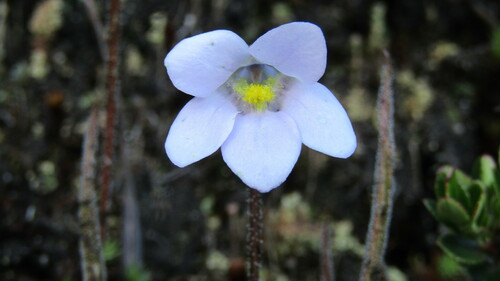
A region, not a single growing strategy
This chapter introduces a geographical part of the encyclopedia. It does not propose a formal botanical group or one potting recipe. To understand a particular plant, start with its accepted identity, then investigate elevation, substrate, water supply and seasonal changes. A country name is useful context, but a poor substitute for those details.
Central American diversity also continues to be documented. Sergio Zamudio and Hermes Vega published Pinguicula hondurensis from Honduras in 2019. That publication belongs in the regional research record; it should not be silently absorbed into a catch-all label such as “Mexican ping”. Source: Zamudio and Vega, original species publication.
Ecuador: neighbouring habitats, different species
A 2023 study by Pérez and colleagues described P. jimburensis and P. ombrophila and reconsidered Ecuadorian P. calyptrata. The authors found neighbouring butterwort populations separated by habitat and morphology, without observed intermediate plants. Their identification key distinguishes the long-lobed, partly upright foliage of P. jimburensis from the flatter rosettes of the other two species. Rock-growing P. ombrophila also differs from terrestrial P. calyptrata in its shorter flower stalks.
The paper records Ecuadorian P. calyptrata across roughly 2,100–4,100 metres. This is a useful reminder that equatorial does not necessarily mean warm at plant level. The published habitats and distinctions are evidence for separating these profiles, not a ready-made indoor temperature programme. Source: Pérez et al., 2023, Contributions to Ecuadorian butterworts.
Colombia: a seasonal exception
In a field account from mountains near Bogotá, Hernandez-Melan described P. elongata growing at about 3,000 metres in páramo vegetation. The observed plants occupied sloping ground that did not remain waterlogged. They produced long leaves during the rainy growing season and short leaves during the drier resting period; night fog remained part of their environment.
This report contradicts a convenient but unsafe assumption that every South American butterwort stays in the same leafy state all year. It also describes a particular population and climate. Its calendar months should not be copied directly into an Australian watering schedule. Source: Hernandez-Melan, 2009, Pinguicula elongata of Colombia.
The far south: what “antarctica” means
Pinguicula antarctica Vahl is a southern South American species. Kew records its native range in southern Chile and southern Argentina and places it in the temperate biome. The name does not mean that it grows on the Antarctic continent. Source: Kew, Plants of the World Online.
The specialist account for P. antarctica describes it as homophyllous: it retains the same general leaf type and does not produce a hibernaculum. That is a species-level distinction. It cannot be extended to every butterwort south of the equator, especially given the seasonal foliage documented in P. elongata. Source: A World of Pinguicula, P. antarctica.
Turning habitat information into useful care questions
Before placing an unfamiliar species alongside established plants, ask what is actually known. Is there a published cultivation account for that species, or only a habitat photograph? Does the report describe continuously moving seepage, fog, seasonal rain or standing water? Does a resting rosette retain leaves, and are its roots active? These questions reveal which parts of a care recommendation are supported and which remain a trial.
For an Australian collection, compare measured conditions at the pot with those reported for the accession. A room's daytime temperature alone says little about its overnight cooling. Likewise, a moist surface does not reveal how much air remains around the roots. Record both the environment and the plant's response before changing several conditions at once.
How the regional library will grow
Individual species profiles will carry the detail that this overview cannot: identification characters, documented range, seasonal behaviour, propagation evidence and uncertainties. Newly described names will be checked against their original publications and a dated taxonomic backbone. A name awaiting review will remain visible in the research queue rather than being presented as settled.
The aim is to make these plants understandable without making them interchangeable. Their differences are the most useful starting point for both a reference library and a living collection.


