

The Caribbean adds some of the most unusual growth forms in Pinguicula. Fine, upright leaves emerge from wet sand, while other species live on tree branches. Their shared membership in the genus does not make them variations on a single Mexican butterwort growing method.
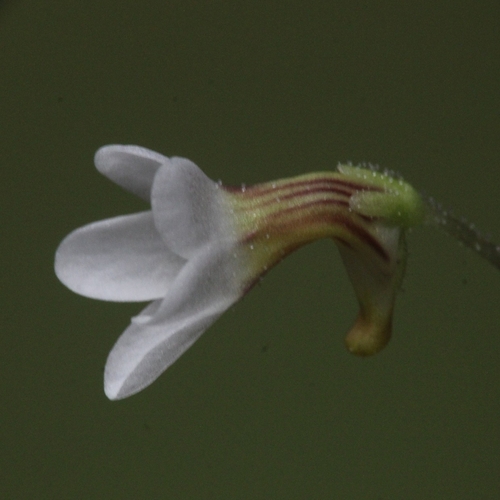
The geographical frame
Casper’s 2019 monograph concentrates on the Greater Antilles, treating Cuban diversity in western, central and eastern regions and the Hispaniolan species P. casabitoana. The work is a dated taxonomic treatment, not a permanent total for every Caribbean island. Its introduction highlights both the thread-leaved P. filifolia and the epiphytes P. lignicola and P. casabitoana. Englera 35: monograph introduction.
The broader regional frame also needs the Bahamas: Kew includes them in the genus’s native distribution. This chapter focuses on the Cuban and Hispaniolan examples for which the sources below provide detailed biological context, while the coverage register tracks the wider species programme. Kew genus distribution.
Wet sand and thread-like leaves
Pinguicula filifolia inhabits western Cuban sandy savannahs. Its specialist account describes wet ground with a white-sand surface and organic material below, as well as narrow, upright leaves. Older accounts describe an unchanging leaf form, but a 2012 field study documents two carnivorous leaf forms during development. This differs from the non-carnivorous succulent rosette familiar from many Mexican species. Field study of development and ecology. Habitat and morphology.
This makes a useful distinction between the material seen at the surface and the whole rooting environment. Filling a pot with one dry-looking ingredient does not recreate a habitat whose lower layers and water supply are different. Record the structure and moisture of a successful medium, not just its colour.
The same grower’s account reports particular difficulty maintaining P. filifolia during cold conditions and stresses the importance of humidity. Those observations justify taking temperature seriously; they should not be converted into experimentally proven universal lethal limits. The profile for this species will distinguish growing experience from measured physiological evidence. Cultivation observations.
Butterworts on trees
Pinguicula lignicola in eastern Cuba and P. casabitoana on Hispaniola are true epiphytes in Casper’s treatment. An epiphyte uses another plant as a support; the word does not mean that it obtains food by parasitising that plant. Greater Antillean treatment.
The description reproduced for P. casabitoana records roots ending in enlarged attachment structures and plants on branch tips. These details are more useful than simply calling it a forest species. Morphological account.
For a grower, the question becomes how a documented method supplies moisture and air around a small attached plant. “Epiphytic” alone does not specify a mounting material, watering interval or terrarium design. Where dependable cultivation evidence is limited, the encyclopedia will say so rather than presenting an untested recipe as established care.
True vivipary: seedlings before dispersal
Temple and colleagues investigated reproduction in P. lignicola and P. casabitoana. Their 2020 paper describes true vivipary: development begins sexually from seeds, and seedlings develop substantially before dispersal, supported within the persistent calyx after leaving the capsule. This differs from the vegetative daughter plants that form on a leaf tip in species such as P. primuliflora. True vivipary in two Caribbean Pinguicula.
The distinction matters for collection records. A seedling is not automatically a clone of its mother, even if it begins growing while still attached. Record whether new material came from seed or vegetative tissue, and retain any known pollination information.
Why the names still need checking
A 2024 study by Yoannis Domínguez reviewed Caribbean name-bearing specimens, designated lectotypes and an epitype, and corrected earlier citations. Typification establishes which preserved material anchors a botanical name; it is not the same as proving that every living plant bearing that name has been correctly identified. Study abstract and publication record.
For each eventual species profile, the editorial record therefore needs an accepted name, its original or revised description, habitat evidence and traceable cultivation observations. An old photograph label is a useful research lead, but it cannot supply all four.
Building a useful Caribbean collection record
- Keep the supplied identity and accession history together.
- Record whether the plant grows in a pot or on a support, including the actual materials.
- Measure conditions beside the plant rather than relying on a room-wide impression.
- Photograph reproductive structures before assuming they are seeds, seedlings or vegetative plantlets.
The Caribbean chapters will develop these distinctions species by species. Their central lesson is practical: the habitat and biology behind a name are what make its care understandable.
Part of the Nano Nursery Pinguicula Encyclopedia. Sources checked September 2026. Care guidance concerns established plants; material leaving tissue culture requires separate acclimatisation.


